logo

The Essential Guide to Ratchet Withdrawing Wire Tighteners: Precision Tools for Overhead Line Tensioning

December 17, 2025

Latest company news about The Essential Guide to Ratchet Withdrawing Wire Tighteners: Precision Tools for Overhead Line Tensioning
In the specialized field of overhead power line construction and maintenance, achieving precise conductor tension is a critical task that directly impacts the safety, efficiency, and longevity of electrical infrastructure. The Ratchet Withdrawing Wire Tightener, often used in conjunction with a conductor grip or "come-along," is a purpose-engineered hand tool designed specifically for this application. Its primary function is to provide controlled, high-mechanical-advantage tensioning, allowing linemen and technicians to accurately set sag, replace insulators, or make repairs on both de-energized and, with proper procedures and insulated variants, energized lines.
For utility companies, electrical contractors, and maintenance crews operating across diverse regions including Central Asia, the Middle East, Africa, South America, and Southeast Asia, reliable and robust hand tools are fundamental to operational success. In these regions, where projects can range from expansive desert grid expansions to mountainous transmission lines and dense urban upgrades, equipment must be both highly effective and exceptionally durable. This guide provides a comprehensive technical overview of ratchet withdrawing wire tighteners, examining their design, operation, and key selection criteria.
To explore our range of professional-grade ratchet tighteners designed for heavy-duty applications, we invite you to visit our product homepage for detailed specifications and performance data.

Understanding the Role of Tensioning in Overhead Lines

Proper conductor tension, manifested as the correct "sag" or catenary curve between support points, is not arbitrary. It is a calculated engineering parameter essential for:
Manual tensioning tools like the ratchet tightener provide the fine, controlled adjustment needed to achieve this precise tension in the field, especially during final sagging or maintenance operations.

Anatomy and Operation of a Ratchet Withdrawing Wire Tightener

This tool is a masterpiece of mechanical simplicity and efficiency. It typically consists of a handle, a ratcheting mechanism, and a wire rope or high-strength synthetic strap. Its operation is based on leverage and incremental motion.
Key Components and Their Function:
  1. The Frame & Handle:​ Constructed from high-tensile steel or aluminum alloy, the frame provides the structural backbone. The handle offers leverage and houses the control mechanisms. Ergonomics are crucial, as operators may need to apply significant force repeatedly.
  2. The Friction Drive / Ratcheting Mechanism (The Core Innovation):
    This is the heart of the tool. Unlike a geared winch, it often employs a friction-based gripping system.
    • Operation:​ The wire rope or strap passes through a set of opposed, serrated jaws or rollers within the tool body.
    • Tightening Stroke:​ When the handle is pumped in the "tighten" direction, the mechanism grips the wire firmly and pulls it a set increment into the tool, taking up slack.
    • Holding Position:​ An internal pawl or friction lock automatically engages, preventing the wire from slipping back out, thus holding the gained tension securely.
    • Return Stroke:​ Reversing the handle or activating a release lever disengages the grip, allowing the jaws to slide freely back along the wire to the next starting position for another pull, without losing tension. This "ratcheting" action allows for continuous take-up over long distances.
  3. The Withdrawing Wire Rope or Strap:
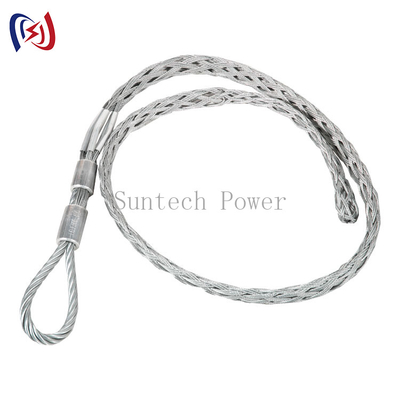
    • Material:​ Traditionally a flexible steel wire rope with a swaged or spliced loop on the free end. Modern versions may use ultra-high-molecular-weight polyethylene (UHMWPE) or aramid fiber straps, which are lighter and non-conductive (safer near live lines).
    • Function:​ This is the element that connects the tightener to the conductor grip. Its flexibility is key to the tool's operation.
  4. Integral Hook or Shackle Point:
    A forged steel hook or clevis is mounted on the tool frame. This is the primary attachment point to the anchor—often the tower structure, a pole, or a ground anchor.
How It Works with a Conductor Grip:
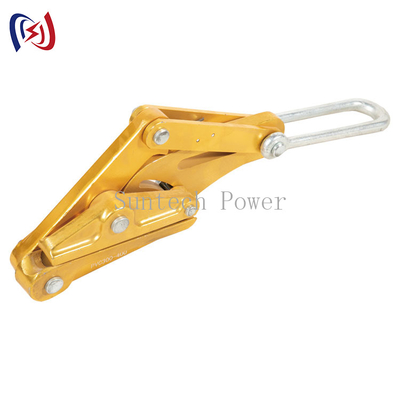
  1. A specialized conductor grip​ (also called a pulling grip or come-along grip) is securely clamped onto the conductor.
  2. The hook of the ratchet tightener is attached to a solid anchor point.
  3. The wire rope from the tightener is passed through or attached to the conductor grip.
  4. The operator pumps the handle. Each stroke ratchets the wire rope into the tool, pulling the conductor grip (and thus the conductor) toward the anchor, applying tension.
  5. Tension is monitored (often with a dynamometer or by sighting sag), and adjustments are made until the desired value is achieved.


Advantages of the Friction/Ratchet Design


A Buyer's Guide: Critical Selection Factors

Choosing the right ratchet tightener is a technical decision impacting safety and job efficiency.
1. Load Capacity – The Primary Specification:
2. Mechanical Design and Durability:
3. Ergonomics and Usability:
4. Specialized Features for Regional Challenges:
5. Manufacturer Reputation and Support:
To assist in selecting a tool that meets the rigorous demands of your regional environment and workload, our website provides detailed comparison charts and technical data sheets for all models.

Operational Best Practices and Safety

Pre-Use Inspection (Mandatory):
Safe Operation:
Maintenance and Storage:


Conclusion: The Lineman's Essential Mechanical Partner

The ratchet withdrawing wire tightener is an indispensable tool in the arsenal of overhead line professionals. Its robust, friction-based design provides a reliable, powerful, and controllable means of applying the precise tensions that are the hallmark of a quality electrical installation. In the challenging environments faced by international utility crews—from the deserts of the Middle East to the tropics of Southeast Asia—the durability, corrosion resistance, and sheer pulling power of a well-made tightener can make the critical difference between a successful, safe job and operational difficulty.
Investing in high-quality, appropriately specified tensioning equipment is an investment in project quality, crew safety, and long-term grid reliability. By understanding the tool's mechanics and selecting the right model for the job, contractors and utilities ensure they have the capability to build and maintain the infrastructure that powers modern society.
To equip your teams with the reliable, professional-grade tensioning tools required for precise and safe overhead line work, we encourage you to browse our comprehensive product catalog and download technical specifications from our website. Make the informed choice for performance, safety, and durability.
Get in touch with us
Contact Person : Mr. Peter Mao
Tel : 86-13958364836
Characters Remaining(20/3000)